Sets and Functions, Chapter 3 took the
natural numbers as a subset of the familiar real
numbers, and borrowed the arithmetic of whenever it was
convenient. This volume builds the integers, the
rationals and the real numbers. If we started from the
inside , the real numbers
would rest on the real numbers. So we need on its own. We make
one assumption: there is a set with a start and a step
that obey three rules. This section shows that each rule
is needed, proves induction in the form we use, and
proves that every natural number except has exactly one
predecessor.
What
counting needs
Two descriptions of come to mind at once,
and neither will do.
The first is . It names four elements and
then writes three dots, and the dots carry all the
content. They say “keep going one at a time, and nothing
else”, and to say what that means is exactly the job of
a definition of .
The second is more careful: is the smallest
subset of that
contains and is
closed under . A smallest such subset exists, by Sets and Functions, Proposition 1.3.2
with start and
step , and the set form of Logic and Proof, Axiom 4.2.1
shows that it is the of Sets and
Functions. Either way the description needs . Since is where this volume
is going, it cannot be where comes from.
So we describe by what counting has
to do, not by where its elements live. Counting
needs
- (P1) a start: an element where
counting begins;
- (P2) a step: a rule sending each
element to a next element of the same set.
That is a set ,
an element ,
and a function . A start and a step are not enough, and
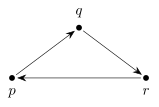
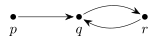
here are three ways they fail to count. In each picture
an arrow goes from to .
A loop. Let ,
start at , and
step .
Counting comes back to its start: three steps after
we are at again, as on a
clock.
A merge. Let
again, start at ,
and step .
Counting never returns to , but two different
elements, and
, step to the same
. After the count repeats , and runs in a circle
from there.
An extra row. Take the counting
numbers, and beside them a second copy with its own
step, which the start never reaches. Every element still
has one next element, no two elements step to the same
one, and nothing steps back to the start. Yet starting
at the start and stepping, we never meet the second
copy. Counting cannot see those elements, and a
description of the natural numbers must exclude
them.
Each failure is ruled out by one clause: the step
never returns to the start; the step never sends two
elements to the same one; and nothing is there that
steps from the start cannot reach. The last clause needs
care, since “reached by steps” is the three dots again.
The way around it is the one Sets and Functions, Proposition 1.3.2
takes: speak of subsets. A subset that contains the
start and is closed under the step contains everything
the steps reach. If the only such subset is the whole
set, nothing is left over.
A Peano system is a set with a start and a step,
where the step is one-to-one, never returns to the
start, and reaches everything.
Definition
1.1.1 (Peano system)
A Peano system consists of a
set , an element
, and a
function , such that:
- (P3)
for every ;
- (P4) is
injective;
- (P5) every subset with and for every
is equal to
.
In words: (P1) and (P2) are built into the data,
since and
maps into . (P3) says the step
never leads back to the start. (P4) says two different
elements never step to the same element. (P5) is
induction for : a
subset that contains the start and is closed under the
step is everything, so every element of is reached from by steps. We write
and not
, so that
the letter never suggests . The notation lists the three
pieces of data; it is not a set built from them (if one
object is wanted, take the pair of Sets and Functions, Definition 1.4.1).
The merge breaks (P4), since with
. The extra
row breaks (P5): the first copy contains the start, is
closed under the step, and is not everything. The loop
is the subject of the first Quick check.
Quick check. For the loop (, , , , ), which of (P3),
(P4), (P5) fail?
Solution. Only (P3): . (P4) holds,
since the three values , , are different. (P5) holds: a subset
containing and
closed under
contains ,
then , so
it is .
The one
assumption
The natural numbers are to be a Peano system. That is
the whole of what we assume about them.
Axiom
1.1.1 (The Natural Numbers)
There is a Peano system.
We fix one Peano system for the rest of the volume
and write it . Its elements are the
natural numbers, is
zero, and is the
successor of . Spelled out, is a set, , is a function, and:
- (P3) for every ;
- (P4) implies ;
- (P5) every that contains and is closed under
is .
Why believe the assumption? If the school real
numbers are trusted, the of Sets and
Functions, with start and step , is a
Peano system; Section 1.4 checks this. And Axiomatic
Set Theory, Chapter 1 builds a Peano system from
sets alone, assuming nothing about numbers; Section 1.5
describes how. Which Peano system we fix does not
matter: Section 1.4 proves that any two are copies of
each other, matched by exactly one bijection that sends
start to start and step to step.
From here on, every fact about is proved from Axiom 1.1.1. We do
not borrow the order, the subtraction or the arithmetic
of . Addition
and multiplication are not defined yet; Section 1.2
defines them. Even the numeral is not available until
then, and the element after is written .
Why these three clauses and no others? Each one does
work that the other two cannot do: for each clause there
is a structure satisfying the other two and failing
it.
Example
(Each axiom is needed)
Show that each of the following structures , with ,
satisfies two of (P3), (P4), (P5) and fails the
third.
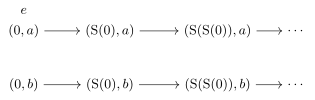
- (i) , , .
- (ii) , , , .
- (iii) (Two
copies of .) Let be two objects,
, , and for and .
Solution.
(i) Fails
(P3): . (P4) holds: has one element, so two
inputs with equal outputs are equal. (P5) holds: a
subset of
containing is
.
(ii) Here by
(P3) for , so
has two elements.
Fails (P4):
with . (P3) holds: both values are
. (P5) holds: if has as an element and is
closed under ,
then , so .
(iii) First,
is a function
. Each
element of is
for some
and (Sets and Functions, Definition 1.4.2),
and for exactly one such pair (Sets and Functions, Definition 1.4.1),
so the formula names one value; and ,
since
maps into .
(P3) holds. If , then
gives (Sets and Functions, Definition 1.4.1),
against (P3) for .
(P4) holds. If , then gives and , so by (P4) for
. Hence .
(P5) fails. Let . It contains , and it is
closed under ,
since . But is not in
, because its
second coordinate is . So .
The picture shows (iii), with an arrow from each
element to its image under .
This is the extra row of the start of the section.
The element
has no arrow coming in, and it is not . The top row is a copy
of , and so is
the bottom row; but the bottom row cannot be reached
from . (P3) and
(P4) cannot prevent this, and (P5) is the clause that
says “nothing else”.
(P5) speaks of every subset of , and that is what lets
it exclude every kind of extra row. A first-order
induction schema speaks only of subsets defined by
formulas, and Logic and Proof, Section 7.6
showed (Logic and Proof, Example (A Model of Arithmetic with an Infinite Number))
that the sentences true in also hold in a
structure with an element beyond every numeral; its
closing remark promised the comparison made here.
Exercise C2 builds an extra row in which, unlike above, every
element has an arrow coming in.
(P5) is induction, stated about subsets of a Peano
system. For we
record it in the two forms the rest of the volume cites:
a set form, and a form about properties.
Theorem
1.1.2 (Induction on )
- (a) (Set form.) Let
. If
, and for
every , then
.
- (b) (Property form.)
Let be a
property of natural numbers, possibly with other
variables as parameters. If holds and,
for every , implies , then
holds
for every .
Proof. (a) This is (P5) of
Definition 1.1.1
for the Peano system of Axiom 1.1.1.
(b) Let (Sets and Functions, Definition 1.2.3).
Then ,
because holds.
Let . Then
, so by
hypothesis, and
because
maps into ; hence . By
(a), , which
says that
holds for every .
Compare part (b) with the principle of induction, Logic and Proof, Axiom 4.2.1.
Read with in place of
, the two
statements are the same, and Section 1.2 shows that
once addition is defined. The
difference lies in their status. In Logic and
Proof, Chapter 4, induction was taken on trust, for
an that came
with the school arithmetic attached. Here (P5) is part
of the one assumption, and arithmetic is not assumed at
all: Section 1.2 builds it, and proves its laws by this
theorem.
Warning. Both halves of the
hypothesis are needed. The set is
closed under , by (P3), and
it is not . The
set contains
and is not closed
under ,
since .
Quick check. Let be “”. Does the base
case hold? Does the step hold? What does Theorem 1.1.2 (b)
conclude?
Solution. The base case holds:
says . The step fails at
: holds, while says
,
which is false by (P3). So the theorem concludes
nothing, and indeed fails at .
Every
natural number except 0 has one predecessor
Sets and Functions used that for every
natural number (Sets and Functions, Lemma 3.1.1
(c)), with the subtraction done in . Our has no subtraction.
Yet Sections 1.2–1.4 split, again and again, into the
cases “” and
“
for some ”. For
that we need every to be a successor, and of exactly one . The fact holds in
every Peano system, and the proof is no harder there;
Exercises B3 and C2 use it in that generality.
Proposition
1.1.3 (Predecessors in a Peano System)
Let be
a Peano system.
- (a) For every with there is
exactly one with .
- (b) for every
.
Idea (Scratch work). For (a), “at
most one” is (P4): if , then . “At least
one” is the real question. Of the three clauses, only
(P5) can prove that every element of has a given property,
and (P5) speaks of subsets. So we must choose a subset
of and show . That choice is the
new point. Inside an abstract nothing can be
computed: there is no subtraction that would produce
from .
The first candidate is the set of values of , . It fails at the start, since
is not a value,
by (P3). The cure is the shape of Sets and Functions, Lemma 3.1.1
(c): carry “
or …”.
| a
Peano system; , |
some
with |
|
; then
and give |
| (P5) for |
; and
, since is a value of |
The step never uses , as in Sets and Functions, Example (An induction that ignores its hypothesis).
Idea. Both parts apply (P5) to a
subset chosen for the purpose: (a) to together with the
values of , and
(b) to the set where . In (b), unlike (a), the step uses its
hypothesis, through (P4).
Proof. (a) Let with . At most
one: if and , then by (P4). At least one: let
(Sets and Functions, Definition 1.2.3).
Then , by
the first alternative. Let . Then is the value of at , so , by the second
alternative with . By (P5), . Hence ; since , the second alternative holds, and for some .
(b) Let . Then
, since
by (P3).
Let ,
so that .
If ,
then (P4), applied to the inputs and , gives , a
contradiction. So , that is, . By (P5),
. This
proves the proposition.
For , part
(a) says that every natural number is for exactly
one ; this
is the
predecessor of . Part (b) says that no
natural number is its own successor.
The two proofs make the same move with one
difference. In (a) the closure step proves outright,
whatever is; in
(b) it needs , and (P4) turns the hypothesis into the
conclusion . The move has a name.
Example
(Method: induction through a closed subset)
Template. (1) Name . (2) Show . (3) Take and show , using if needed. (4)
Conclude by
(P5). If fails at
, carry “ or ” (the shape of Sets and Functions, Lemma 3.1.1
(c)).
When to use it. A statement about
every element of a Peano system whose elements are not
known one by one: an abstract , the image of a
map out of , a
set of pairs.
The usual failure. A property false
at . Closure
checked only for elements of a special form (), forgetting
. (P5) applied to
a set that is not a subset of .
On the
method is Theorem 1.1.2 (b),
and Sets and Functions, Example (Method: finding inside ) still finds
inside in the
step; the box adds the choice of the set.
Solution. The element : . So “exactly one” in (a) fails
at , because (P4) fails; and (b)
fails at , since .
Quick check. Does the loop (, , , ) satisfy the
conclusion of Proposition 1.1.3
(a)? What does the answer say about a converse?
Solution. Yes. Every element, included, has exactly
one element stepping to it: to , to , to . Yet the loop is not a
Peano system, since it fails (P3). So the conclusion of
(a) does not give back the axioms; Exercise C2 shows
that it does not even together with (P3) and (P4).
The next section uses each of (P3), (P4) and (P5) to
prove that a function on can be defined by
recursion, and then defines addition and
multiplication.
Exercises
A. Check your
understanding
Exercise
(A1)
- (a) For each of the
three structures in Example (Each axiom is needed),
which of (P3), (P4), (P5) fails?
- (b) In the proof of
Proposition 1.1.3
(a), which axiom gives at least one , and which gives at
most one?
- (c) Is
closed under ? Is it ? Which hypothesis of
Theorem 1.1.2 (a)
fails for it?
- (d) True or false:
in a Peano system , the function is a bijection .
Solution.
- (a)
(b) At least one
comes from (P5), applied to the set of elements that are
or a value of
. At most one is
(P4).
(c) Yes: for
, and
by (P3). No: is not in it. The hypothesis that fails is
.
(d) False. The
function is
injective, by (P4), but not surjective: is not a value of , by (P3) (Sets and Functions, Definition 2.2.2).
B. Practice
Exercise
(B1: Put the proof in order)
Let be
a Peano system. The following lines contain a proof that
for every , shuffled, together with two lines
that do not belong. Write the six correct lines in an
order that makes a proof, say which other orders are
also admissible, and say why each of the other two lines
fails.
(i) Let ; we show .
(ii) Let .
(iii) Then by (P4),
contradicting .
(iv) , since is a value of
, so it is not
, by
(P3).
(v) Suppose .
(vi) So , that
is, ; by
(P5), .
(vii) Since is a bijection, write
and apply
the hypothesis to .
(viii) Since
, and
every element is reached from by steps, for every
.
Solution. An admissible order is
(ii), (iv), (i), (v), (iii), (vi):
Let . Then , since is a value of
, so it is not
, by (P3). Let
; we show
. Suppose
.
Then by
(P4), contradicting . So , that is, ; by (P5),
.
Line (ii) comes first, since every other line
mentions . Lines
(i), (v), (iii), (vi) come in that order: (i) opens the
closure step, (v) opens a supposition, (iii) applies
(P4) to the inputs and and reaches a
contradiction, and (vi) closes the supposition and
applies (P5), which needs both and the closure
step. So (iv) may stand right after (ii) or right after
(i), before the supposition (v) opens; it must come
before (vi), which uses it. Stating the base case first,
as above, is the convention.
Line (vii) cites a false fact: is not surjective,
since is not a
value, by (P3). Citing an unavailable “fact” is (N9) of
Logic and Proof, Example (What is not allowed).
Line (viii) is an “and so on” with nothing behind it:
“every element is reached from by steps” is (P5) only
if the step from
to is proved,
and line (viii) never proves it. That is (N13).
Solution. (P3): for , by (P3) for , applied to .
(P4): if , then , so by (P4) for , and then by (P4) again.
(Equivalently: is
a composite of two injections, so it is injective by Sets and Functions, Theorem 2.2.1
(a).)
(P5) fails. Let . It
contains , since
by (P3). It is closed under : let ; then , and ,
because would give by
(P4), against (P3). But , since and
. So a subset of with as an element and
closed under need
not be all of .
The step skips
, and
starting from it
meets only , ,
,
…: every second number.
Exercise
(B3: Prove or disprove)
Let be
a Peano system. Prove or disprove each statement.
- (a) If contains
and is closed
under , then .
- (b) If is
non-empty and closed under , then .
- (c) Every in is for some with .
- (d) If
satisfies
and for every , then .
- (e) Every is or for some .
Solution.
(a)
True. The set is a subset
of containing
. It is closed
under : for , by hypothesis;
for , by closure. By
(P5), .
(b)
False. Let . It contains , since by (P3), so it
is non-empty. It is closed under , since no value of
is , by (P3). It misses
, so .
(c)
True. Let . By Proposition 1.1.3
(a) there is with . If , then , against Proposition 1.1.3
(b). So .
(d)
True, by Example (Method: induction through a closed subset).
Let . Then , since . If , then , so . By (P5),
. So and have the same
domain, the same codomain and the same value at every
, and by Sets and Functions, Proposition 2.1.1.
(e)
False. Take . It is
not , by (P3). If
for
some , then
by (P4),
against (P3). So is neither nor of the form .
C. Going deeper
Exercise
(C1: A Peano system with a different start)
Give an example of a Peano system with and . Check every
clause of Definition 1.1.1.
Solution. Any correct answer has: a
set ; an element with ; a function , so that every value lies in
; and the three
clauses (P3), (P4), (P5) for these data.
Take , , and for .
- The data. ,
since and by
(P3) for . For
,
since
maps into , and by
(P3) for , so
. So is a function, since is one and its
values on lie in
(Sets and Functions, Definition 2.1.1).
- (P3). If for
some , then
, so by (P4) for ; but .
- (P4). If with , then by (P4) for .
- (P5). Let with and
for every .
The set contains and is closed under
: ; and for , . By Theorem 1.1.2 (a),
. Every
lies in
and is not
, so . Hence .
Other answers can be checked against the four
properties at the start. For instance, , , also works, by the same argument
with added in (P5).
Exercise
(C2: Every element but one is a successor, used
later)
Let be
three different objects, , , and,
for ,
- (a) Explain why
is a function
.
- (b) Show that satisfies (P3)
and (P4).
- (c) Show that every
with is a value of
.
- (d) Show that fails
(P5).
- (e) Which
conclusions of Proposition 1.1.3
hold in ?
Solution (Hint 2). For (d), try the
set .
Solution.
(a) Each element
of is for some and (Sets and Functions, Definition 1.4.2),
and for exactly one such pair (Sets and Functions, Definition 1.4.1).
For and , one formula
applies and names one value. For , the first
coordinate is or
for
some , by
Proposition 1.1.3
(a) for ; never
both, by (P3) for ; and the is unique. So exactly
one line of the definition applies to each element, and
it names one value. The values lie in , since .
(b) Sort the
values by their second coordinates (Sets and Functions, Definition 1.4.1):
(P3) holds. A value equal to would have
second coordinate , so it would be with
,
against (P3) for .
(P4) holds. Suppose . The two
values have the same second coordinate, so they come
from the same row of the display. In the first row,
gives by (P4) for
. In the third
row, gives , so . In the second row, because ; so
either both values are of the form , and
as
before, or both are , and both inputs are . In every case
.
(c) Let . If
, then , so for
some (Proposition 1.1.3
(a) for ), and
. If
, then , or
and . If
, then .
(d) The set contains
, is closed under
, since , and misses , since . So it is a subset of containing , closed under , and not equal to .
(e) Both. Part
(a) of Proposition 1.1.3
holds: a predecessor exists by (c), and it is unique by
(P4), proved in (b). Part (b) holds: and , since in
(Proposition 1.1.3
(b)); , since ; and , since . So
neither conclusion of the proposition gives back (P5),
even together with (P3) and (P4).
The picture to keep in mind: the elements with second
coordinate form a
copy of ,
starting at . The
elements with second coordinates and form one chain running
forever in both directions. Read as “” and as “”: the step moves
one place to the right everywhere, with , playing , stepping to , playing . Every element of the
chain has an arrow coming in, and none of it is reached
from .