Addition in
is addition of arrows in the plane: puts the second arrow at the tip of the
first. Multiplication has a picture too, and Section 1.2
already holds half of it: the modulus of a product is
the product of the moduli (Theorem 1.2.2
(d)). The other half is about angles, and angles need
the functions cosine and sine, which this volume does
not construct. This section first proves everything
about directions that needs no angle at all, then states
exactly five facts about cosine and sine that it
borrows, and from those five builds the polar form of a
complex number and the rule “multiply the lengths, add
the angles”.
Length and
direction
Every non-zero complex number should be a length
times a direction. The length is the modulus. The
directions are the complex numbers of length , and they deserve a
name.
The unit circle is the set of complex numbers at
distance from
.
We write for the unit circle. For
with
, the
condition says , that is, : both sides
of the first equation are non-negative, so it holds
exactly when the squares agree (Number Systems: From to , Proposition 2.3.5
(g)). So is the
circle of radius
about in the
plane. It contains , , and , and also ,
since . It does not contain , whose modulus is
.
The next proposition collects what the multiplication
of does on
. None of it
uses an angle.
Proposition
1.5.1 (The Unit Circle)
- (a) . If , then . If , then and .
- (b) For every with there is
exactly one pair with , , and , namely and .
- (c) For with : if and
only if .
Idea. Every part is a statement
about moduli, so each follows from the rules of Section
1.2: moduli multiply, ,
and only has
modulus . For (b),
divide by its
length; for the uniqueness, take moduli of .
Proof.
(a) By Proposition 1.2.1,
the modulus of the real number is its absolute value,
which is ; so
. If ,
then by Theorem 1.2.2 (d).
Let . Then
, since
(Theorem 1.2.2
(e)). By Theorem 1.2.2 (c),
, so satisfies the
defining equation of . Since is a field (Theorem 1.2.4),
inverses are unique (Number Systems: From to , Lemma 4.1.1
(a)), and . Finally by Theorem 1.2.2
(d).
(b)
Existence. Let . Then , and because (Theorem 1.2.2
(e)); so ,
and its inverse is a positive real
number (Number Systems: From to , Proposition 2.5.2
(a)). By Theorem 1.2.4 the
inverse of in
is this real
number, so is defined, and . By Theorem 1.2.2 (d)
and Proposition 1.2.1,
, where
because the absolute value of a positive real number is
the number itself (Number Systems: From to , Definition 4.1.1).
So .
Uniqueness. Let with and . Taking moduli,
, again by Theorem 1.2.2 (d)
and Proposition 1.2.1.
Then . So the pair is the one named in the
statement.
- (c) Since inverses
are unique, holds if and only if , that is,
by Theorem 1.2.2 (c),
if and only if . Both and are non-negative, so by
Number Systems: From to , Proposition 2.3.5
(g) neither can be strictly smaller than the other, and
holds
if and only if .
Part (b) is the picture we wanted: , a
length times a direction, and both factors are forced.
Part (a) says that the directions are closed under
multiplication and inversion and contain ; Algebraic
Preliminaries, Chapter 2 calls a set with these
properties, under an associative product, a group, and
is one of its
first examples. Part (c) is a practical test: on the
unit circle, and only there, dividing by is the same as
conjugating.
Quick check. Write as with and . What is ?
Solution. By Proposition 1.5.1
(b), and . By (a), . Check: .
So far a direction is a point of , and multiplying two
directions gives a third. What we cannot yet say is
how much a direction turns the plane.
For that we need to measure positions on the circle by a
real number, an angle, so that multiplying directions
adds angles. That is a job for cosine and sine.
What this
volume borrows about cosine and sine
An angle should be a real number that walks around
the circle: a point
on , moving as
moves,
returning to its start after a full turn of length . Defining such
functions needs limits of functions, by power series or
by integrals. This volume develops no limits of
functions, so it does not define cosine and sine.
Analysis on the Real Line, Chapter 10 does:
there and
are defined by
power series,
is defined as twice the least positive zero of , and the facts below
are proved. Its
is a complete ordered field, so by Number Systems: From to , Theorem 6.3.1
it is our , up
to the one order-preserving field isomorphism; the
functions and the number carry over along it.
We write , the integer
multiples of
in .
Axiom
1.5.2 (What This Volume Borrows about Cosine
and Sine)
There are functions and a real number with the
following properties. They are assumed here and
proved in Analysis on the Real Line, Chapter
10.
- (T1) for every .
- (T2) For all ,
- (T3) For : if and
only if .
- (T4) For every with
there
is
with
and .
- (T5)
whenever .
In words: (T1) puts the point
on the unit circle; (T2) is the pair of addition
formulas; (T3) says that the cosine reaches exactly at the
multiples of a full turn; (T4) says that every point of
the circle is reached; (T5) says that during the first
half turn the point stays in the upper half plane.
This box is where the chapter borrows. Like Logic and Proof, Axiom 4.2.1,
which Logic and Proof assumed and Number
Systems: From
to ,
Chapter 1 proved, it is a statement assumed in one
volume and proved in another. Nothing in Sections
1.1–1.4, and nothing in this section above the box, uses
it. From here on we use these five facts about , and and no
others: no value such as ,
no periodicity, no picture of a graph. Whatever else we
need, we derive, and each proof that uses one of the
facts names it by its number. Two consequences come at
once.
- , by
(T3), since . Then (T1) gives , so
, because
a non-zero real number has a positive square (Number Systems: From to , Proposition 2.3.5
(e)).
- and for every , by (T3) and then (T1) in the same
way.
Warning. The five facts are about
, and only. A school fact
such as is not among them, and a proof in this
volume may not quote it: Example (Special Angles)
below derives the few values we use. Nor do the facts
say that and
are “periodic
with period ”
as functions; that is true, and derivable from (T2) and
(T3), but no proof here needs it.
With angles available, we can name the point of at angle .
is the point of the unit circle at angle .
In words: the first line is an abbreviation, not an
exponential. This volume has no exponential function,
the letter on its
own means nothing here, and the only rule of exponents
we will use for is the one
proved below (Theorem 1.5.3
(a)). Analysis on the Real Line, Chapter 10
shows that is indeed the
value of the complex exponential function at ; the notation
anticipates that, and the linear algebra volumes write
their roots of unity with it. The exponent may be
written in any form equal to with real, and the
symbol then means : for example
, , and . This is unambiguous, because the
real number
is determined by (it is its
imaginary part). The second part asks for a
positive real and allows
any real .
The point lies on . Indeed , by Definition 1.2.1
and (T1). So is a length times a direction, as
in Proposition 1.5.1
(b), and that proposition gives for every
polar form of .
Examples.
- , by the consequences of the box. So and
are
polar forms.
- , by the second consequence with
. So as
well: and are both arguments
of , and they
differ, since .
- The number
has no polar form, since .
A non-example by minimal change.
Allow :
then looks like a polar form of with argument . The clause that fails
is , and it
matters: with negative allowed, the length
could no longer be read off as , and and
would share the argument . We will see in Example (Special Angles)
that is a genuine polar form.
The examples already show why the definition says
an argument: .
How much freedom there is, exactly, is part (b) of Proposition 1.5.4
below. First, the reason for the notation: these numbers
multiply the way exponentials do.
Theorem
1.5.3 (Multiplication in Polar Form)
- (a) for all .
- (b) , and for every .
- (c) If with and ,
then ,
and this is a polar form of the product.
Idea. Multiply out with
the rule of Definition 1.1.1:
the real and imaginary parts that appear are exactly the
right-hand sides of the addition formulas (T2). The rest
is bookkeeping with inverses and moduli.
Proof.
(a) By the
multiplication rule of Definition 1.1.1,
where the second equality is (T2), with the
two products in the imaginary part reordered by
commutativity in . The right-hand side
is .
(b) was shown in
the first example above. By (a) with , , so is the
inverse of , by
uniqueness of inverses in the field (Theorem 1.2.4, Number Systems: From to , Lemma 4.1.1
(a)). Since , its inverse is also its conjugate (Proposition 1.5.1
(a)).
(c) By Proposition 1.1.2
(commutativity and associativity of ), , and (a) turns
this into . Here by Number Systems: From to , Proposition 2.3.5
(c) (multiply by ), so this is a polar form.
In words: to multiply two complex numbers,
multiply their moduli and add their arguments.
This is the chapter’s third named move, multiply
moduli, add angles. Multiplying by a fixed
therefore turns the plane about by the angle and stretches it
by the factor .
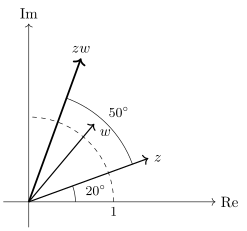
The picture shows , and for , , and
arguments of and (a full turn
being ,
that is, ).
The arrow for
has length and makes the angle with the positive real axis: it is the
arrow for , turned
by the argument of and stretched by the
modulus of . The
small arc marks the argument of , the large arc the
extra turn by the argument of , and the dashed arc is
part of the unit circle, where the numbers live.
Now the freedom in the argument. Every non-zero
number has a polar form, and its arguments are
determined up to a whole number of full turns.
Proof.
(a) By Proposition 1.5.1
(b), with , so . By (T4) there is with and , that is,
.
Hence , with .
Conversely, if is a polar form, then , and
the uniqueness in Proposition 1.5.1
(b) gives .
(b) Suppose first
that . The number is
non-zero: ,
is non-zero (Proposition 1.5.1
(a)), and a product of non-zero elements of the field
is non-zero (Theorem 1.2.4, Number Systems: From to , Lemma 4.1.1
(d)). So both sides are polar forms of the same non-zero
number, and
by (a). Multiplying by gives . In the other direction, if , the two sides are
equal exactly when . So it remains to show that if and only if .
Multiplying by , and back
by ,
shows that holds if and only if , that is, by Theorem 1.5.3 (a)
and (b), if and only if . Comparing real and imaginary parts, this
says and . The second condition follows
from the first: by (T1), gives , hence (Number Systems: From to , Proposition 2.3.5
(e)). So if and only if , and by (T3) that holds if and only if .
Existence came from (T4), and uniqueness from (T3),
with (T1) helping and (T2) entering through Theorem 1.5.3.
“Comparing arguments” therefore always means comparing
them up to a multiple of , and the next
warning is the trap this sets.
Warning. From one may not
conclude : , and . Only follows (Proposition 1.5.4
(b)). Forgetting this loses solutions as soon as an
equation is solved for an angle; Section 1.6 meets an
equation where it would lose all but one of them.
Powers
Repeating Theorem 1.5.3
gives powers. The powers are those of the
recursion ,
(Proposition 1.1.3).
Theorem
1.5.5 (De Moivre’s Formula)
For every and every , Consequently for every
real , and
this is a polar form.
Idea. A power is a repeated
product, and each new factor adds to the argument,
by Theorem 1.5.3 (a).
So induction on ,
along the recursion .
Proof. We use Logic and Proof, Axiom 4.2.1
on , read on through Number Systems: From to , Corollary 1.7.3
(b); here
is the product in of and (Number Systems: From to , Definition 4.2.1
(a)). For ,
the left side is by
the recursion, and the right side is by Theorem 1.5.3 (b).
Suppose for some . Then by the recursion, the induction hypothesis, Theorem 1.5.3 (a),
and (Number Systems: From to , Definition 4.2.1
(a)) with distributivity in . This proves the
formula for every .
For the consequence, Proposition 1.1.3
(c) gives . The
power is the
same whether it is computed in or in , by the remark after
Proposition 1.1.3
in Section 1.1, and because a product of positive reals is
positive (Number Systems: From to , Proposition 2.3.5
(c); induction on , with ).
For a negative exponent, Exercise C1 below defines
locally and
proves the matching formula; nothing in the text uses
it.
The five borrowed facts give no particular value of
or except at multiples
of . Every
other value this chapter uses is derived next, from
(T1)–(T5) and the algebra of Sections 1.1–1.4.
Example
(Special Angles)
Show, using only (T1)–(T5) and the results proved so
far, that
Solution. Each value is found the
same way: a power of the unknown point is a point we
already know, and (T5) chooses between the candidates.
Since ,
each of ,
, , lies strictly
between and , so (T5) gives for each of them.
(i) . Let
. By Theorem 1.5.5,
, so , and since has no zero divisors
(Theorem 1.2.4, Number Systems: From to , Lemma 4.1.1
(d)), or
. Suppose
. Then , so for some
by (T3);
dividing by gives in ,
an equation between images of integers. The embedding of
into , through (Number Systems: From to , Proposition 2.4.4)
and (Number Systems: From to , Theorem 5.6.3),
is injective and preserves and , so holds in . But is odd,
and an odd integer is not of the form (Number Systems: From to , Corollary 3.1.3
(a)). So ,
and .
(ii) . Let
. By Theorem 1.5.3 (a),
, so and . Since and , .
(iii) . Let .
By Theorem 1.5.5,
. Multiplying out shows . Now , since ; so . By Corollary 1.4.2
with , , , and ,
a square root of (indeed ), Since , .
(iv) . Since ,
Theorem 1.5.3 (a)
and (b) give by (ii) and (iii).
(v) . Let .
By Theorem 1.5.3 (a)
and (ii), . The formula of Proposition 1.4.1
for (so , , ) gives
the square root , and ,
since both are non-negative and square to . By Proposition 1.4.1
(b), or , and rules out . So .
Comparing real and imaginary parts turns these into
values of and
:
|
|
|
|
|
|
|
|
|
|
|
|
|
|
These are the familiar values, now proved from the
five facts.
Two special cases of the rotation picture are worth
isolating. Multiplying by turns the plane by a quarter turn,
counterclockwise; two quarter turns make a half turn,
and this is the picture behind . And
multiplying by undoes the turn by (Theorem 1.5.3
(b)).
Powers that are tedious to expand become one line in
polar form.
Example
(A Power via Polar Form)
Compute .
Quick check. Use polar form to
compute ,
and check the answer with .
Exercises
A. Check your
understanding
Solution.
(a) and , by Example (Special Angles)
(i) and (ii); the moduli and are positive, as a
polar form requires. (Any ,
respectively , with , is also an argument, by Proposition 1.5.4
(b).)
(b) False. ,
but
since .
What is true is (Proposition 1.5.4
(b)).
(c) Existence:
(T4), which provides an angle for the point of . Uniqueness: (T3),
which turns into ; (T1) is used alongside it, to see that
follows from , and (T2) enters through Theorem 1.5.3,
which turns into .
(d) Everything in
Sections 1.1–1.4, and the part of this section before Axiom 1.5.2; after
the box, only Exercise C2, which is set up to avoid
them. In particular Proposition 1.5.1
uses none of them: its proof uses only the modulus rules
of Section 1.2, the field properties of , and order facts
about from
Number Systems: From to .
B. Practice
Solution. By Theorem 1.5.3 (b),
, that is, . Comparing real and
imaginary parts gives and .
By Theorem 1.5.3 (a)
and Example (Special Angles)
(i), , that is,
. Comparing parts gives the next two
identities.
By Theorem 1.5.3 (a)
and Example (Special Angles)
(ii), .
Comparing imaginary parts gives . (Comparing real parts gives, in
addition, .)
Solution. Let ,
so . Squaring the modulus, by Theorem 1.2.2
(a)–(c), and . Hence .
Now if and
only if (Theorem 1.2.2
(e)), if and only if (a real number is exactly when its square
is: by Number Systems: From to , Proposition 2.3.2
(b), and a non-zero square is positive by Number Systems: From to , Proposition 2.3.5
(e)), if and only if , that is, .
C. Going deeper
Solution.
(a) Write
and . By Theorem 1.5.5,
. Now , and Comparing real parts and using (T1), . Comparing imaginary parts and using
,
.
(b) By Theorem 1.5.3 (b),
. By Theorem 1.5.5
applied to ,
.
Nothing in this chapter uses negative powers of
complex numbers; the definition in (b) is for practice
only.
Solution (Hint 1). For (b), on the
unit circle the conjugate is the inverse: .
Solution (Hint 2). Clearing the
denominator, is equivalent to , and
, so
is determined; it
remains to show that is real.
Solution.
(a) The real part
of is , so and the
quotient is defined. The numbers and are conjugate, so
they have the same modulus (Theorem 1.2.2
(d)), which is non-zero. From and
Theorem 1.2.2 (d),
, and canceling the
non-zero real number gives . If , then , so , which is false. So .
(b) Let with , and let . Since , the
equation is
equivalent to , that is, to Since , this holds if and only if , where . So at most one real has , and one does
exactly when is
real. Using , where by Definition 1.2.1
(with ,
); and , by Theorem 1.2.2 (a),
(c). This is a positive real number, since . Multiplying
numerator and denominator of by , a real number. So exactly one has , namely .
(c) Multiplying
numerator and denominator by the conjugate of the
denominator, Check against (b): .
So the map is a bijection from onto , and
it was found with no angle. For rational , the point has rational
coordinates: the computation in (c) with in place of gives , and gives the point
behind
the right triangle with sides , , .
Marking scheme. (10 points) - 2:
with a
reason, and from the equal moduli of conjugates. - 1:
. - 2:
rewritten
as a linear equation in , with used to solve
it uniquely. - 3: shows that the unique solution is real
and equals , with justified (for example by multiplying by
and
using , with ). - Second route
(coordinates , ): the two lines above (5 points) become 2 for
splitting into and , showing (otherwise ) and so is forced; and 3 for checking that this
satisfies , using . - 2: (c)
computed and checked. Fatal errors (0 for the step):
writing and using a half-angle formula
(borrowed facts, and values not derived here); dividing
by without showing it is non-zero.