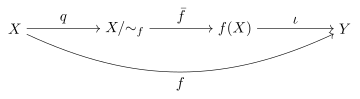
Section 4.2 cut a set into classes, and Section 5.1
cut functions down and glued them together. This section
joins the two threads. Every function sorts its domain
into piles by value, the fibers, and we prove that the
piles carry all the information the function has, apart
from the names of the values: every function is a
quotient map, then a bijection, then an inclusion. Read
in reverse, the same argument says exactly which
functions on a set pass to a function on a quotient set,
and gives a method for defining one.
Functions
on the clock
Section 4.2 built the clock , whose elements
are the twelve hours . Some questions about an
integer are really questions about its hour. “Is even?” is one: and name the same hour, and
both are even;
and name the same
hour, and both are odd. In general, let be a
function with so that
takes one value on each class modulo . Then “is” a function of the
hour: to compute it at an hour, pick any integer naming
that hour and apply . The condition is
stated for all pairs in one class at once. A condition
such as for every says the same thing in
the end, but getting from it to for
every
takes an induction in each direction.
Other functions are not functions of the hour. “Is
positive?” gives
different answers at and at , which name the same
hour, so no function on can answer it.
There is a second way into the same idea, from the
side of an arbitrary function. A function sorts
its domain: put two points in one pile when gives them the same
value. Section 4.2 met these piles as the classes of the
relation (Example (The fibers of a function)).
So every function produces a quotient set of its
domain.
Two questions organize the section.
- (Q1) Given an equivalence relation
on , when does a function
on pass to a
function on , and is the
function it passes to unique?
- (Q2) What does a function look like
once its domain has been sorted by value?
We answer (Q2) first, because its answer contains the
answer to (Q1).
The fibers
of a function
Recall the relation of Example (The fibers of a function).
For and , means . It is an equivalence relation on
, and the class of
is the
fiber of over , a preimage in the sense of Definition 1.7.2.
A fiber over a point of that never takes is empty,
and so is not a class.
The fibers of a function are the piles it sorts
its domain into, one pile for each value it
takes.
Proposition
5.2.1 (The Fibers of a Function)
Let be a function.
- (a) The fibers over the
points
are exactly the classes of , and they form a
partition of .
- (b) The rule
is a bijection . Hence .
Idea. Part (a) is already proved:
Example (The fibers of a function)
identified the classes with the fibers, and Theorem 4.2.1
says the classes partition . For (b), a fiber over
a value is a class, so the rule lands in ; every class
is the fiber over the value at its representative, which
is surjectivity; and two different values have different
fibers, because a point of the first fiber is not in the
second.
Proof. (a) Let , say with (Definition 1.7.1).
Then , by the computation in
Example (The fibers of a function);
so each such fiber is a class. Conversely, each class is
for some , and
with .
So the fibers over the points of are the elements of
, and
these form a partition of by Theorem 4.2.1
(d).
(b) By (a), each is sent to an
element of , and to only
one, so the rule is a function (Definition 1.5.1).
It is surjective: an element of is for some , and by (a).
It is injective: let with , and write
with . Then ,
while because . So
, and different values have
different fibers. Hence is a bijection (Definition 1.5.5),
and by Definition 2.5.1.
So a function takes exactly as many values as it has
fibers, in the sense of equinumerosity: the values and
the piles can be paired off. The partition remembers
which points share a value, and forgets only what the
values are called.
Quick check. List the classes of
for on , and
match each class with its value.
Solution. The values are , , , , . So the classes
are
(value ), (value ) and (value ): three classes for
the three values in .
The proposition explains a computation of Section
4.2. In Example (Same size, revisited),
the subsets of were sorted by “same number of elements”.
That relation is for the function
sending each subset to
its number of elements, a function by Proposition 2.5.6
(every subset has some number of elements, at most ) and Corollary 2.5.4
(only one). Its four fibers are , the three
singletons, the three pairs, and , and its
image is all of . Part (c) of that example, the well-defined
map from classes to numbers, is the bijection of (b)
read backwards.
Quick check. List the fibers of
, where is the remainder of
on division by
.
Solution. ,
, . Three fibers, three values; every
value is taken, so is the whole
codomain.
Every
function factors
Now (Q2). The quotient map , (Definition 4.2.4),
sends each point to its fiber. The bijection of Proposition 5.2.1
(b) goes from values to fibers; turn it around, and it
sends the fiber
to the value .
Finally, a value of lies in the image , and the
inclusion map ,
(Definition 5.1.1),
puts it back into the codomain. Composed, the three maps
take to , to , to . That is .
Theorem
5.2.2 (Canonical Factorization)
Let be a function, let
be the quotient map, and let
be the inclusion map. There is exactly
one function with It is given by , and
it is a bijection.
Idea (Scratch work). The only
candidate is forced. If , then , since changes no value.
So uniqueness costs nothing, and the work is to show
that the forced rule is a function and a bijection. The
rule reads a representative, so the first check
is well-definedness, by the method of Example (Method: checking that a definition on classes is well defined).
The twist is in the table’s third row: injectivity is
the well-definedness line read backwards.
| (Theorem 4.2.1
(b)), and |
a
function, bijective, , unique |
|
: one class, one value, (Fn2), well
defined |
|
:
injective, the same equivalence read right to left |
| , so
with |
: surjective |
Uniqueness: is
onto, so every class is for some ; a second with has at every class. The proof
writes this forwards.
Proof. A function. Every
element of is for some , and by Definition 1.7.1;
this gives (Fn1). Let . By Theorem 4.2.1
(b), , that is, . So all
representatives of one class give one value, which is
(Fn2), and defines a function (Definition 1.5.1).
Injective. Let , that is, . Then
,
and
by Theorem 4.2.1
(b).
Surjective. Let . By Definition 1.7.1
there is
with , and
then .
The factorization. Both and have domain and codomain , and for every , by Definition 1.5.2.
Hence by Proposition 1.5.1.
Uniqueness. Let satisfy . Every element
of is
for some
, and where the first equality holds because sends each point to
itself. The two functions have the same domain and
codomain, so by Proposition 1.5.1.
This proves the theorem.
Read the factorization from left to right: every
function is a surjection (, onto by Definition 4.2.4),
followed by a bijection (), followed by an
injection (, which sends each
point to itself, so different points stay different).
All the identifying is done by , all the renaming by
, and all the
enlarging of the target by . The two properties
of Section 1.5 sit at the two ends. The function is injective exactly
when is: if is injective and , then
by
Theorem 4.2.1
(b), so and ; if is injective and , then
, so
by
Theorem 4.2.1
(b), and . And is surjective exactly
when , that
is, when .
Warning. The middle map is a
bijection onto the image, not onto the
codomain. With target , the rule is still
a well-defined injection, but it is surjective only when
is. For on , the rule maps the
classes
onto
and reaches no negative number of the codomain .
The factorization also explains a failure from
Section 1.5.
Example
(Fractions as classes)
Let , .
Describe ,
the three maps of Theorem 5.2.2,
and decide whether “send to its numerator
” passes through
.
Solution. The relation.
means , and since this holds exactly when , by the
arithmetic of fractions. It is the relation of Exercise
B1 in Section 4.2 (Exercise (B1: Fractions as classes)),
now seen as the fiber relation of a function; that it is
an equivalence relation is also immediate from Example (The fibers of a function).
The class of
is the fiber over : the pairs , all the ways of writing one half as a
fraction.
The three maps. The quotient map sends a pair to its
class, “the fraction up to rewriting”. The
map sends a
class to the rational number its pairs all name. And
is onto , since every rational
number is for
some and
;
so and
. By
Theorem 5.2.2,
is a
bijection from the set of classes onto : a rational number
“is” a class of fractions, and nothing is lost by
identifying the two.
The numerator. Let . If
were for some
function on the
classes, then would force . But ,
since , while . So does not pass through
, and no function
on the classes, hence none on , sends each fraction
to its numerator. This is the failure of Example (Relations that are not functions)
(b), located: the numerator is a function of the pair,
not of its fiber.
Solution. is surjective, and not
injective, since . is both, by Theorem 5.2.2.
is injective,
as every inclusion is; here it is , so it is also
surjective.
Functions
out of a quotient
Now (Q1). The canonical factorization built a
function on the classes of from itself. Nothing in its
first step needed the relation to come from : what made a
function was only that equivalent points have equal
values. So the same argument works for any equivalence
relation, as long as the function is constant on its
classes.
Theorem
5.2.3 (Functions out of a Quotient)
Let be an
equivalence relation on a set , let
be its quotient map, and let be a
function.
- (a) There is a
function with
if and only if is constant on
classes: for all , if , then . In that
case is
unique, and .
- (b) Suppose is constant on classes.
Then is
injective if and only if, for all , implies
.
- (c) Suppose is constant on classes.
Then is
surjective if and only if is surjective.
Proof. (a) Suppose
,
and let . Then by Theorem 4.2.1
(b), so
Suppose is
constant on classes. Every element of is for some , with , which is
(Fn1). If , then by Theorem 4.2.1
(b), so , which is (Fn2). Hence defines a function (Definition 1.5.1).
Both
and have domain
and codomain
, and for every , so by Proposition 1.5.1.
Uniqueness. If also satisfies , then each
element of
is for some
, since
is onto (Definition 4.2.4),
and . So by Proposition 1.5.1.
(b) By Definition 1.5.3,
is injective
when implies for all . Every class is for some , and ; so
the condition reads: for all , implies
. By
Theorem 4.2.1
(b),
is .
(c) By Definition 1.5.4,
is
surjective when every is for some class . Since every class is
for some , and , this
says that every is
for some :
that is
surjective.
The canonical factorization is the case where is , with the function , . That
is constant on
the classes of by the definition
of ; the
converse condition of (b) holds for the same reason, so
is
injective; and is
onto by Definition 1.7.1,
so is
surjective by (c). The map is .
Warning. “Constant on classes” runs
from equivalence to equal values: . Its converse, , is the injectivity condition of
(b), and checking it instead proves nothing about
existence. For congruence modulo and , the
converse holds, since gives ; but
while ,
so “” is not a function.
The theorem turns the check of Example (Method: checking that a definition on classes is well defined)
into a complete method: it says what the check buys, and
how to read off injectivity and surjectivity
afterwards.
Example
(Method: define a function on a quotient)
Template. (1) Write the function
on that the rule computes
from a representative. (2) Check that is constant on classes
(Example (Method: checking that a definition on classes is well defined)).
(3) Conclude by Theorem 5.2.3:
exists, is
unique, and . (4) Read injectivity of as “equal values
force equivalence”, and surjectivity of as surjectivity of
.
When to use it. Maps out of , out of classes of
fractions, out of any “the same in some respect”.
The usual failure. Proving (4)’s
converse condition instead of (2); a not defined on all of
; running the
check for a map into a quotient, which
needs none: compose with .
Here is the method three times, twice on the clock
and once on .
As in Section 4.2, the subscript in names the modulus:
it is the class of in .
Example
(Maps out of the clock)
(a) Let
send each integer to its remainder on division by . Show that “” is
a function , and decide whether it is injective and
whether it is surjective.
(b) Do the same
for “”, from .
(c) Show that
“” is a bijection .
Solution. The remainder is well defined by
the uniqueness in Theorem 2.2.3.
We use the remainder test of Section 4.2, after Proposition 4.2.4:
if and only if and leave the same
remainder on division by .
(a) Step
(1). The rule computes from the
representative ,
so . Step
(2). Let , so with
. Then
with , so
, and by the remainder test. Step
(3). By Theorem 5.2.3
(a), is a function : “is
the hour even?” is a question about the hour. Step
(4). It is surjective by Theorem 5.2.3
(c), since
and . It is
not injective, by part (b) of the theorem: , but ,
since
lies strictly between and and so is not a
multiple of (Proposition 2.1.2
(c)). So with .
(b) Step
(2). If , then by the remainder test. Step
(4). Conversely, gives , again by the remainder
test, so the induced map is
injective by Theorem 5.2.3
(b), and surjective by part (c), as in (a). It is a
bijection: the two classes of are the even and
the odd integers, matched with the remainders and .
(c) Steps
(1)–(3). Here , a function . If , then
, so (Theorem 4.2.1
(b)). So is a function , the
tick of the clock. A
bijection. In the same way, , so is a function . For
every ,
and ; so and are the
identity of
(Proposition 1.5.1),
and is a
bijection with inverse (Theorem 1.6.4).
In (c) the codomain is itself a quotient set, and the
check compared outputs as classes. In (a) and (b) the
codomain is , and outputs were compared as numbers. Step
(2) of the method is the same check in both cases; only
the meaning of “equal outputs” changes with the
codomain.
↺Second readingSurjections
are quotient maps, and choosing
representatives
If is onto, then , and Theorem 5.2.2
reads with a bijection. So every
surjection is a quotient map up to renaming the classes:
to give an onto map out of is to give an
equivalence relation on and names for its
classes. In the other direction, itself is onto, so it
has a right inverse by Theorem 3.2.2,
which uses Axiom 3.2.1.
Then ,
that is,
for every class :
a right inverse of a quotient map is a choice of one
representative from each class. For no axiom is needed,
since the remainder picks one, the
remainder of on
division by (Proposition 4.2.4).
Quick check. Is the rule a
well-defined function ? Is it injective? Is it
surjective?
Solution. Take ,
.
Well defined: yes. If with
, then
,
so
(this was Exercise B3 (c) of Section 4.2).
Injective: no. , but ,
since ; by Theorem 5.2.3
(b), the classes have one image.
Surjective: yes, by (c), because is the quotient map of
congruence modulo , which is onto.
Exercises
A. Check your
understanding
Exercise
(A1)
- (a) For ,
,
find the fibers over , over and over . Which of them are
classes of ?
- (b) Let send and to , and and to . Write down , , and of Theorem 5.2.2.
- (c) Which of the
functions , and , from , are constant on the
classes of congruence modulo ?
Solution.
(a) means , so the fiber
over is . means , so the fiber
over is . would need
, and no
real square is negative, so the fiber over is . The first two
are classes, since and lie in ; the empty fiber
is not a class, because and every class is non-empty (Theorem 4.2.1
(a)).
(b) The fibers
over the values are and , so . The image is . The
bijection is , , and sends and . The value is in the codomain but
outside the image, which is why is not
surjective.
(c) Let with
, the
general element of the class of modulo . : yes,
since . : no. , but , since
lies
strictly between
and . : yes,
since , with .
B. Practice
Exercise
(B1: The absolute value, factored)
Let , . Describe the classes of , the image and the bijection
. Then show
that is a well-defined injective function .
Solution. The pieces.
holds exactly when or , so the class
of is , which is for . Every value is , and every is , so . The
bijection of Theorem 5.2.2
is , from the set of classes onto .
Well defined. Let . Since
,
gives . So is constant on classes,
and
is a function by Theorem 5.2.3
(a).
Injective. Let . Then
with , and Logic and Proof, Theorem 2.4.5,
applied in both orders, gives
and . So , that is, . By Theorem 5.2.3
(b), the induced function is injective. (It is not
surjective onto : no class goes to
.)
Exercise
(B2: Same fibers)
Let and be functions. Prove that if and
only if there is a bijection
with
for every .
Solution. Let be such a bijection,
and let . If , then . If , then ,
and because is injective. So : the two relations contain the same
pairs, and are equal (Definition 1.2.1).
Suppose ; write for both, so the two
quotient sets are one set . By Theorem 5.2.2
there are bijections and with and . The
inverse is a bijection (Definition 1.6.2,
Theorem 1.6.4),
so is a bijection
by Theorem 1.5.4
(c). For every , , since ; so
.
Exercise
(B3: A coarser relation)
Let and
be
equivalence relations on a set such that implies
.
Show that is a well-defined surjection .
Give the instance .
Solution. Apply Theorem 5.2.3
to the relation and to , the quotient map of . It is constant
on -classes: if
, then
by
hypothesis, so by Theorem 4.2.1
(b). By part (a), is a function, and by part
(c) it is surjective, since is onto (Definition 4.2.4).
For , the hypothesis is:
implies . This holds by Proposition 1.1.1,
since
().
So is a well-defined surjection: each hour
is sent to its position within a block of four hours
(, and go to ).
Exercise
(B4: Prove or disprove)
Prove or disprove each statement.
- (a) If is
constant on the classes of an equivalence relation on and is surjective, then
is a bijection.
- (b) For every
function , .
- (c) If is
injective, then the quotient map is a
bijection.
- (d) The rule
is a bijection .
- (e) If
satisfy , then .
Solution.
(a)
False. Let , let be equality, and let
be the constant function. It is constant
on classes (every function is, for equality) and
surjective. But with , so is not injective. Surjectivity of gives surjectivity of
only, by Theorem 5.2.3
(c).
(b)
True. This is Proposition 5.2.1
(b).
(c)
True. If , then , so
by
injectivity; hence for every . The quotient map is injective: gives
by
Theorem 4.2.1
(b), so .
And is onto by Definition 4.2.4.
(d)
False. Let .
It is constant on classes modulo : if , then
.
The induced map is injective by Theorem 5.2.3
(b): if , then for
some , so
after cancelling .
But it is not surjective, so by part (c) of the theorem,
look for a class that misses. If ,
then
for some ,
so
and . That
is impossible: with , so by the uniqueness in Theorem 2.2.3
the remainder of
on division by is
, not . So is
missed.
(e)
False. Take , and . Both are
injective, so and are both equality
on , but .
Equal fiber relations make the functions differ only by
a renaming of values, which is Exercise B2.
C. Going deeper
Exercise
(C1: Equal fibers)
Let , let
be a set with
elements, and let be a function such that the
fiber
has exactly
elements for every . Prove that .
Solution. For , let be the statement:
for every , every set with elements, and every
all of whose fibers over have elements, . We prove for every by Logic and Proof, Axiom 4.2.1,
with fixed.
Base case . Here , so is a function , and
by Proposition 1.5.2
(b). Then :
for , a
bijection would give a value in . So .
Inductive step. Suppose , and let have elements and have every fiber of elements. Put and . Every has or , and not
both, so and . By Proposition 2.5.6,
has elements for some . Let , ;
this is a function, because
for .
For , its
fiber is , since every with lies in ; so it has elements. By , . The fiber has elements by hypothesis,
so Proposition 2.5.5
gives that has elements. Since also has elements, by Corollary 2.5.4.
This proves .
The statement says that a function whose fibers all
have one size cuts into equal piles, so
the size of is
the number of piles times the pile size. With fibers of
different sizes the same induction gives the sum of the
fiber sizes.
Marking scheme. (10 points)
- 2: states the induction hypothesis with and quantified inside
it.
- 2: the base case : and .
- 3: the step: and are disjoint with union
, the fibers of
are fibers
of , and .
- 3: the conclusion by Proposition 2.5.5
and Corollary 2.5.4.
Fatal errors (0 for the step): induction with fixed; applying to a function whose
fibers were not shown to have elements.
Exercise
(C2: Find the error)
A student proves the uniqueness clause of Theorem 5.2.3
(a) as follows.
- Suppose and
both satisfy and . (2) Then . (3) The quotient map is injective, so can be cancelled on the
right, and .
Is the conclusion true? Which line fails, and why?
Give a counterexample to the failing step, and repair
the proof.
Solution. The conclusion is true:
it is the uniqueness clause, proved in the text. Lines
(1) and (2) are correct. Line (3) fails twice. First,
is injective only
when every class is a single point (the second reading
after Theorem 4.2.1),
which the theorem does not assume. Second, even for an
injective map ,
need not give .
Counterexample to the step. For congruence
modulo on ,
with , so
is not injective,
and the claim “ is
injective” is false in the very case the clock needs.
Counterexample to the inference. The inclusion
is injective; let and
be the constant
function . Then
but .
Repair. What cancels on the right is that
is
onto. Replace (3) by: “Let . Since
is surjective (Definition 4.2.4),
for some
, and then
by (2). The two functions have
the same domain and codomain, so by Proposition 1.5.1.”
Injectivity of
would let one cancel on the
left, in , which is a different
situation.
Marking scheme. (10 points)
- 2: says the conclusion is true.
- 3: identifies line (3), and says either that need not be injective
or that injectivity does not license cancelling on the
right (surjectivity does).
- 2: gives a concrete non-injective quotient map, such
as
modulo .
- 3: repairs the proof by surjectivity of : every class is , where both
functions take the value .
Fatal errors (0 for the step): calling the conclusion
false; a repair that assumes classes are singletons.
Exercise
(C3: Exit check: depends only on f)
Let and be functions such that, for all , implies
.
- (a) Prove that there
is exactly one function with for every
.
- (b) For ,
, decide
whether
and whether are of the form for some
function .
Solution.
- (a)
Existence. The hypothesis says that is constant on the
classes of .
By Theorem 5.2.3
(a), there is a function with . By Theorem 5.2.2,
, , is a bijection, so it has an inverse
(Theorem 1.6.4),
and for every . Put . Then, for every ,
Uniqueness. Let both satisfy the condition. Let ; by Definition 1.7.1,
for some
. Then .
The two functions have the same domain and codomain, so
by Proposition 1.5.1.
- (b) is of this
form: , so on works, and by (a)
it is the only such . is not: if
for
every , then , which is false. The hypothesis of
(a) fails at the pair : , while .
Marking scheme. (10 points)
- 2: recognizes the hypothesis as “ is constant on the
classes of ”
and obtains
with (or defines
directly and checks it is well defined).
- 2: uses the bijection onto , or an equivalent
argument, so that
is defined at every point of and only there.
- 2: verifies for every .
- 2: uniqueness, using that every point of is a value .
- 2: part (b): for ; the witness pair
for .
A direct proof that defines for
any with earns the first
two steps if it checks that the value does not depend on
the choice of
(that is the hypothesis) and that every has such an
. Fatal errors (0
for the step): defining on all of without a value for
points outside ; proving the
converse implication instead
of using the hypothesis.